After years of managing IT infrastructure and implementing security practices, I’ve learned a lot about keeping web applications secure. Here’s what actually matters, without all the corporate buzzword nonsense.
The Stuff That Actually Matters
Look, I could write a novel about web security, but let’s focus on the common vulnerabilities that cause real problems. These aren’t theoretical - they’re issues I’ve seen and had to defend against in production environments.
Input Validation: Trust Nothing
This is security 101, but you’d be surprised how many vulnerabilities stem from trusting user input. If data comes from a user, a URL parameter, a cookie, or literally anywhere outside your server - validate it. Sanitize it. Question its very existence.
File upload forms that accept any file type are a classic example - they can lead to remote code execution if an attacker uploads malicious code. Don’t be that app.
What to do:
- Whitelist acceptable inputs, don’t blacklist bad ones
- Validate on the server side - client-side validation is a suggestion, not security
- Use parameterized queries for database interactions (seriously, just do it)
SQL Injection Still Exists (Unfortunately)
Yeah, it’s 2025 and SQL injection vulnerabilities are still out there. It’s a preventable issue that still causes major breaches. If you’re concatenating strings to build SQL queries, stop. Right now. Use prepared statements or an ORM that handles this for you.
# Don't do this
query = f"SELECT * FROM users WHERE username = '{username}'"

# Do this
cursor.execute("SELECT * FROM users WHERE username = %s", (username,))
It’s not hard. There’s no excuse.
XSS: The Gift That Keeps Giving
Cross-Site Scripting is everywhere. Users paste stuff into forms, you display it on a page, and suddenly someone’s session cookie is being sent to an attacker’s server. I’ve seen XSS in comment sections, profile pages, search results - anywhere user input gets displayed.
The fix is simple: escape output. Use your framework’s built-in functions. Don’t try to roll your own sanitization - you’ll miss something.
Authentication Done Wrong
Password security is not optional. Here’s the baseline:
- Hash passwords with bcrypt, Argon2, or scrypt (not MD5, not SHA1)
- Enforce reasonable password requirements (length matters more than complexity)
- Implement rate limiting on login attempts
- Use HTTPS everywhere (Let’s Encrypt is free, there’s no excuse)
- Consider multi-factor authentication for anything sensitive
I’ve dumped password databases that used MD5 with no salt. The whole database was cracked in minutes. Don’t let this be you.
Session Management
Sessions are tricky. I’ve seen applications that:
- Never expire sessions
- Use predictable session IDs
- Don’t invalidate sessions on logout
- Store sensitive data in cookies
Your session IDs should be random, long, and regenerated after login. They should expire after a reasonable time. And for the love of all that’s holy, use the HttpOnly and Secure flags on session cookies.
Defense In Depth
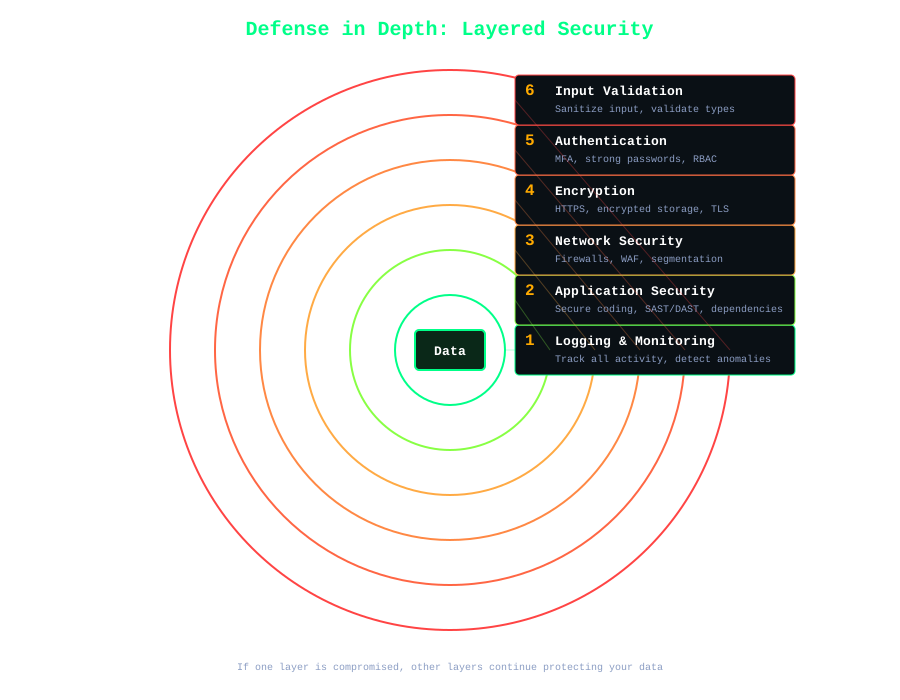
One security control isn’t enough. I’ve bypassed WAFs, evaded input filters, and worked around security tools more times than I can count. Layer your defenses:
- Input validation at multiple points
- Output encoding everywhere user data is displayed
- Proper authentication and authorization checks
- Security headers (CSP, X-Frame-Options, etc.)
- Regular updates of dependencies and frameworks
- Logging and monitoring to catch attacks in progress
The Reality Check
Perfect security doesn’t exist. I’ve never seen a web application that was completely bulletproof. The goal isn’t perfection - it’s making your app hard enough to attack that hackers move on to easier targets.
Every web app has a threat model. A personal blog doesn’t need the same security as a banking application. Understand your risks and protect what matters.
Testing Your Security
Don’t wait for someone like me to find your vulnerabilities during a pentest. Test yourself:
- Use tools like OWASP ZAP or Burp Suite to scan your apps
- Review your code for common vulnerabilities
- Enable security scanners in your CI/CD pipeline
- Read the OWASP Top 10 and check if you’re vulnerable
- Consider hiring a professional pentester for critical applications
Final Thoughts
Web security isn’t rocket science, but it requires discipline. Most breaches I’ve seen happened because someone took a shortcut, skipped validation “just this once,” or figured their app was too small to be a target.
Attackers don’t care how big you are. Automated scanners hit everything. Script kiddies try the same exploits on every site they find. One vulnerability is all it takes.
Secure your applications. Your users are counting on you, whether they know it or not.
Want to learn more? Check out the OWASP Top 10 and my collection of security scripts and tools.